Physics of Life I
Part I
Weeks 1–7

Richard Neher
Part II
Weeks 8–14

Sebastian Hiller
Part I – weeks 1–7
How general physical principles govern the organization of biological processes
- Scales and units: sizes, energies, concentrations, orders of magnitude
- Dynamical systems: differential equations to describe biology
- Gene regulation: transcription factor binding and genetic circuits
- Random walks and diffusion: fluxes, Stokes-Einstein relation
- Polymers: DNA and the cytoskeleton
Part II – weeks 8–14
Physical concepts to describe molecular processes of life quantitatively
- Classical thermodynamics: states, kinetic gas theory, entropy
- Statistical thermodynamics: Maxwell-Boltzmann and Gibbs distributions
- Thermodynamic potentials: the four laws of thermodynamics
- Reaction kinetics, enzymes, cooperativity
- Stability of biomolecules: protein stability and denaturation
Physics is very effective in simple and controlled systems
- Laws of physics connect fundamental particles and forces.
- These laws explain properties of simple systems and homogeneous matter
- Good understanding of systems at equilibrium or isolated systems
- These laws also govern complex systems, but the connection between the laws and the behavior is hard to decipher
Biological complexity
- Biological systems evolved -- layering complexity
- Cells consist of thousands of molecular species, interacting in complicated ways
- Biology is always in flux.
Physics vs Biology
 Wikipedia, by Brews Oshare
- Equations that govern the dynamics
- Exact predictions of future configuration
- Good understanding what is relevant, and what can be ignored.
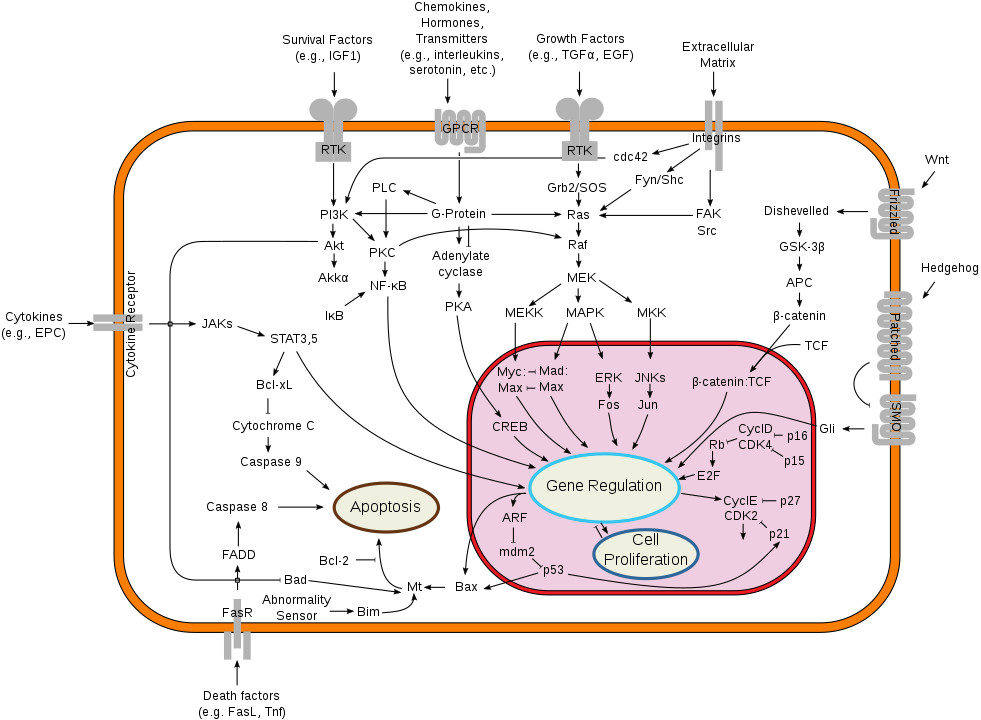 Wikipedia, by cybertory
- Long, but incomplete, list of components
- Only qualitative description of interactions
- Perturbations are often binary
From description to quantitative understanding!
Quantitative questions
- How many human cells are in your body?
- How many other cells?
- How many ribosomes/signaling molecules are in a cell?
- How do genes regulate each other?
- How rapidly does a protein move from one end of the cell to another?
- What fraction of transcription factors is bound to DNA?
- What are the speed limits for biochemical reactions?
- What are the maximal efficiencies of molecular machines?
- How are polarities and developmental gradients set up?
- Not: Gene X causes Y
- But: 20% faster diffusion of gene X extends the gradient by $20\mu m$
Dimensions
- length
- weight
- energy
- current
- force
- temperature
- ....
Units:
- length: meters, miles, feet, Angstrom
- weight: grams, stones,
- energy: Joules, calories
- current: ampere
- force: Newton
- temperature: Celsius, Kelvin
- ....
- Dimensions describe the nature of a quantity
- Units are conventions to measure them
Comparing quantities
- Only quantities of the same dimension can be compared: length $X$ is greater than length $Y$ etc. There is no sense is which length $X$ can be greater than weight $Y$.
- Units are conventions -- there is nothing fundamental about them.
- Some unit systems are more convenient than others.
- Everyday units are often inconvenient for biological processes.
- We can pick units to make things as simple as possible.
- Laws of physics connect quantities of different dimensions.
High level aims of this course
- Understand how physics constrains biological processes.
- Draw connections between processes at the molecular, organelle, cellular, and organism level.
- Enable you to reason quantitatively about biological problems.
On AI use in this course
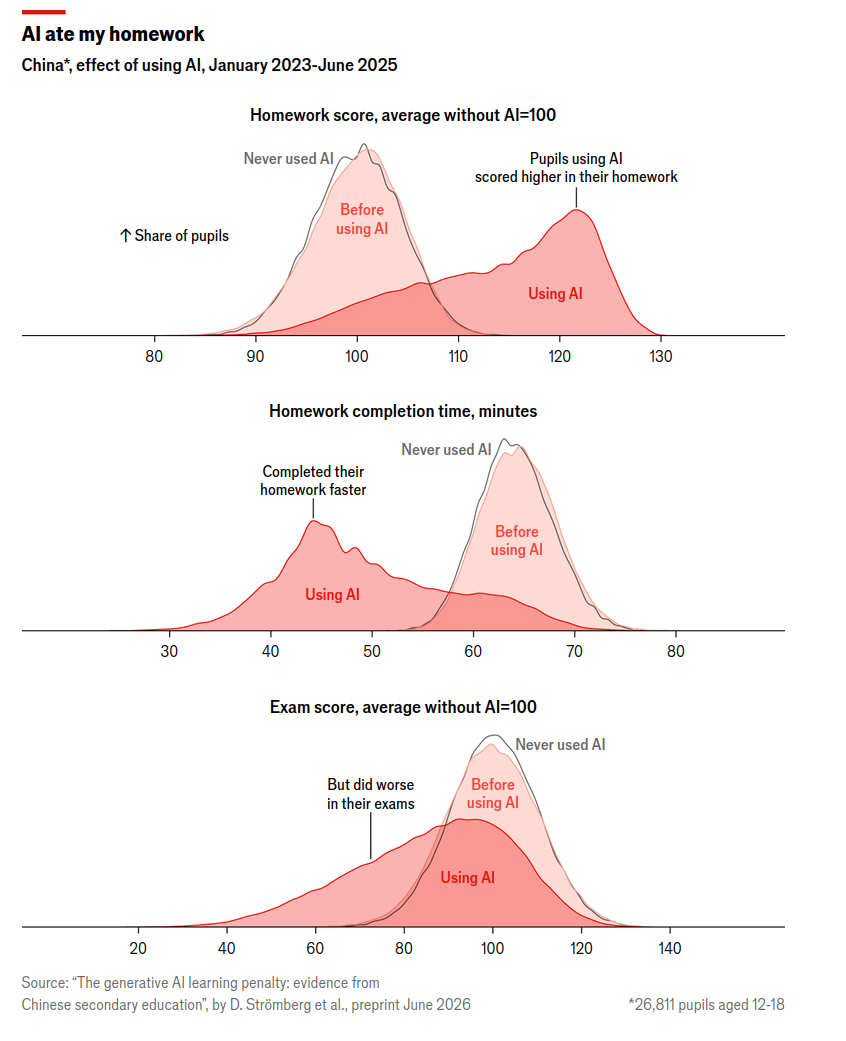
You are here to acquire new skills – and no AI can acquire it for you.
I don't have perfect guidance, but this is my recommendation:
Don't use AI as a shortcut
- Everything in this course is well known – an LLM solves every exercise instantly.
- An AI solution of an exercise might earn you the points, but you have missed a learning opportunity.
- Getting stuck, and getting unstuck, is where the learning happens.
- You want to be the one in the driver seat -- that takes work!
AI as a tutor
- Ask for a hint, not for the solution.
- Ask it to explain the same idea in three different ways.
- Solve it yourself first, then ask it to find your error.
- When programming, outline the algorithm first for yourself. Make sure to keep it simple.